
Artwork, collectibles and other tangible assets can represent millions of dollars in family wealth, yet they are often overlooked in insurance, estate planning and governance discussions.
According to UBS’s Global Family Office Report, alternative assets now comprise approximately 44% of the average family office portfolio. While artwork and antiques represent only a small portion of that allocation on average, many families hold collections that carry substantial financial, historical and sentimental value. At the same time, fewer than half of surveyed family offices reported having formal governance frameworks or wealth succession plans in place, underscoring the importance of integrating significant assets into a comprehensive planning strategy.
For many affluent families and family offices, some of the most valuable assets are not found in investment portfolios or operating businesses, but hanging on walls, displayed in homes or stored in vaults and warehouses. Artwork, collectibles, rare memorabilia, jewelry, wine collections and other tangible assets can represent millions of dollars in family wealth. Yet these holdings are often among the least reviewed, least documented and least strategically managed assets on a family’s balance sheet.
As a result, families may be exposed to unnecessary risks ranging from inadequate insurance coverage and outdated valuations to estate planning complications, ownership disputes and missed opportunities for tax-efficient transfers, particularly when collections have not been reviewed as part of a broader wealth planning strategy.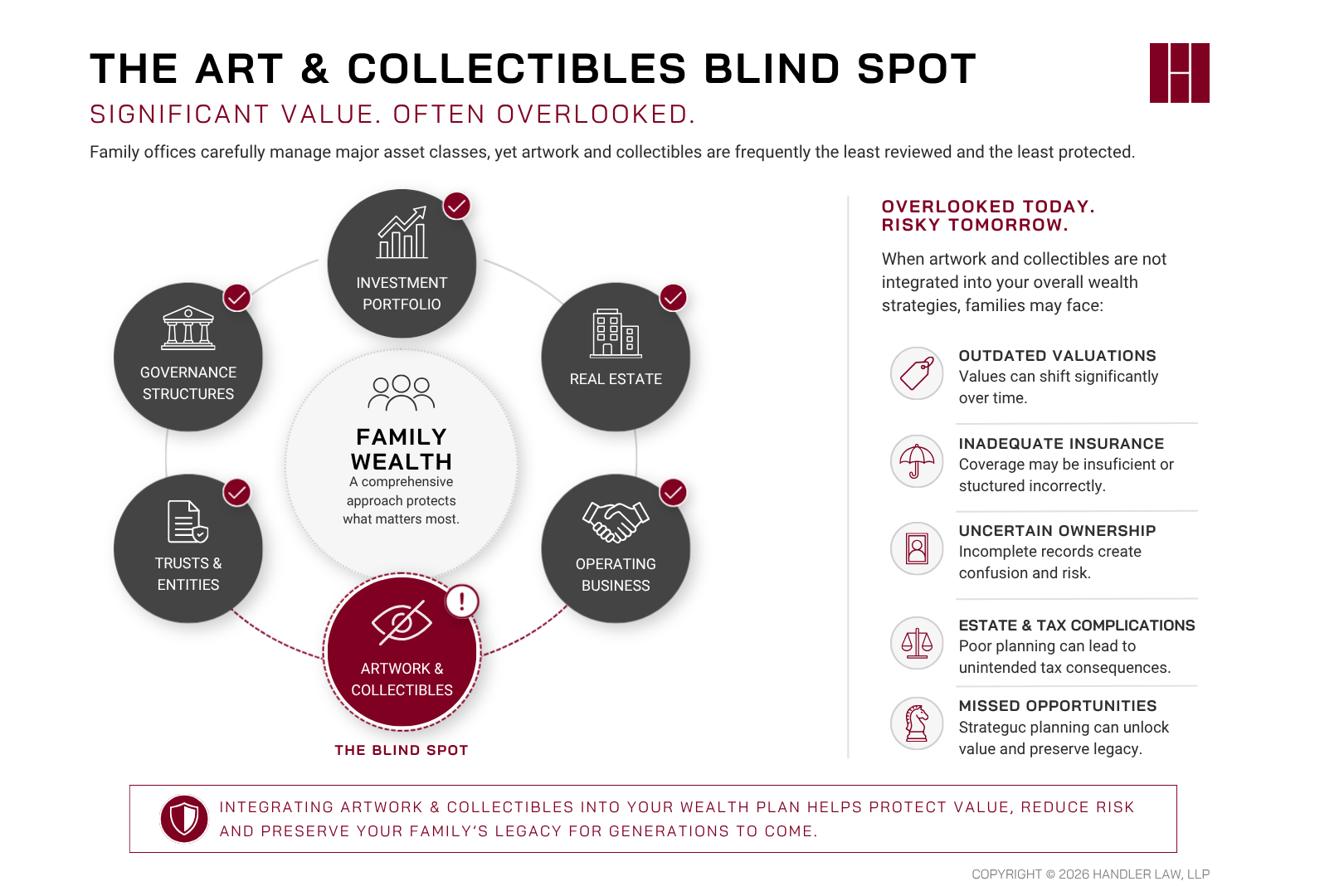
Families intent on passing artwork to the next generation often need to begin by identifying correct values as well as current ownership structures prior to planning. Active collectors as well as families and estates looking to families and estates looking to sell, transfer or deaccession works need trusted advisors familiar with the nuances of the current art market to navigate valuations, estate planning, governance structures, estate administration and transfer issues, as well as how to protect themselves when working with gallerists and auction houses. For example, when consigning artwork to a gallery, families should ensure that consignment agreements contain provisions protecting their ownership rights and recovery remedies in the event of a gallery’s insolvency or bankruptcy.
Whether a collection consists of a few significant works or an extensive multi-generational portfolio of tangible assets, families and family offices should periodically review valuations, ownership structures, insurance coverage and transfer strategies. Proper planning can help preserve both the financial value of a collection and the legacy it represents for future generations.
Artwork and collectibles often carry both significant financial value and deep personal meaning. Integrating these assets into a family’s broader wealth, estate and governance planning can help preserve both. Contact Handler Law to discuss the ownership, protection and transfer of artwork, collectibles and other tangible assets.